Hist ric Hartfrd Synaggues
Although a synagogue structure is not necessary for Jewish prayer, the building of a synagogue represents the creation of a center for both worship and community. In a synagogue, Jews join together not only to pray, but to study, socialize, educate their children, and to care for the needs of their own members as well as the larger community. There were once thirteen synagogues in Hartford, CT. There are no longer any active congregations remaining in the city, although a number of the buildings are still in existence. Some are abandoned and have fallen into disrepair, and others have been repurposed, often as churches. This web exhibit utilizes the archive of the Jewish Historical Society of Greater Hartford to offer images and information on the synagogues that once existed in Hartford.


Beth Hamedrash Hagodol Synagogue
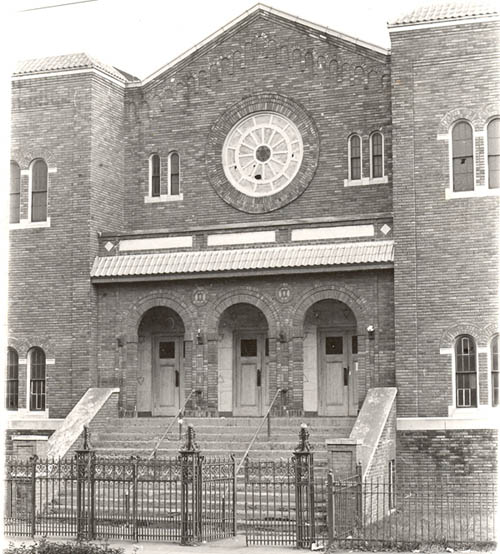
Highlights
- Date of Construction: 1922
- Address: 370 Garden Street
- Nickname: Garden Street Synagogue
- Architectural Style: Romanesque Revival
- Architect: Berenson & Moses
- Branch: Orthodox
Beth Hamedrash Hagodol, an Orthodox congregation, was organized in 1905 on Wooster Street in Hartford's East Side. In 1921, Beth Hamedrash Hagodol merged with Shaarey (Sharah) Torah, and together they built the Garden Street Synagogue. This followed the migration pattern of members of the congregation, who were leaving the crowded East Side for the more prosperous North End. In 1962, the congregation moved again after merging with Ateres Kneset Israel to become the United Synagogue of Greater Hartford in a new facility at 840 North Main Street, West Hartford.
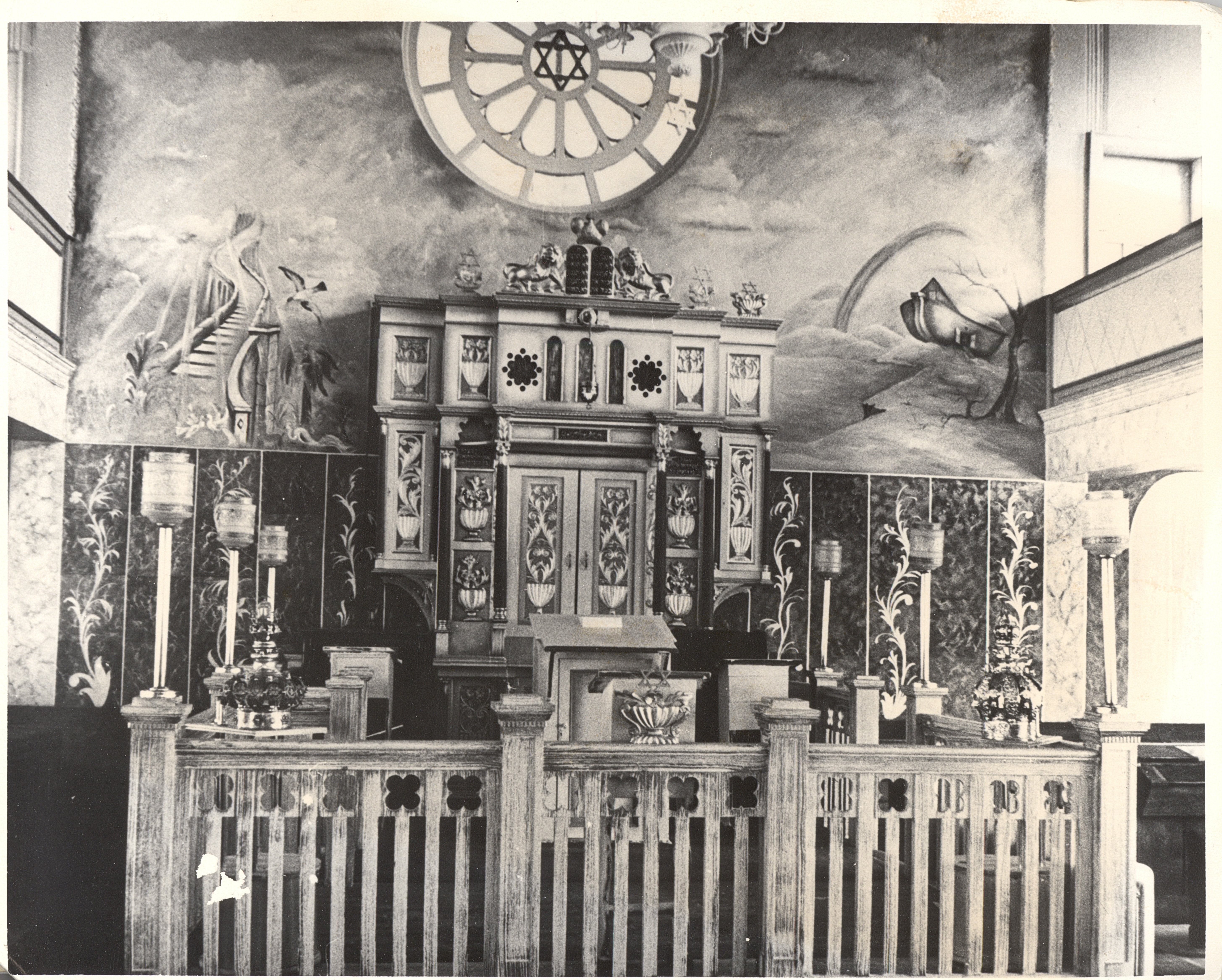
The historic photograph (right) shows the east end of the interior. A wooden rail with quatrefoil frieze between paneled posts separates the main space of the sanctuary from the area of the bimah, lectern, and ark. Traditionally, the reader's platform or bimah, was located in the center of the room so that the Torah, when read from the lectern on the bima, was surrounded by people. In the typical revised arrangement, as found in Beth Hamedrash Hagodol, the bimah is grouped with the ark for convenience and the Torah is carried up and down the aisles to continue the tradition of being among the people.
The ark, a large stepped cupboard, is elaborately decorated with painted panels of foliate and urn designs and marbleizing. The wall behind the ark is embellished with a mural of the road to heaven and Noah's Ark. Above is a second wheel window, similar to that on the facade, but with a Magen David in its center. The ark was removed from the building and is now on display at the Jewish Historical Society of Greater Hartford.